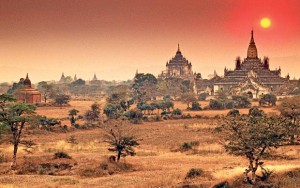
Shwezigon
Situated about half a mile west of Nyaung U, Shwezigon Pagoda has three terraces, bell shape, embossed circular rings, down-turned and up-turned lotus petals, celestials stairways and so forth, like a sacred reliquary of typical early Bagan architecture, built by King Anawrahta of Bagan, as guided by Shin Arahan in 421 ME, finished by King Kyansittha, enshrining various relics of Buddha. At its four facades were all standing-posture images of Buddha. It has nine wonders (1) it’s umbrella being stead-fast without being fastened with cable (2) its shadow not extending beyond its walls (3) gold leaf papers dropped from atop not getting beyond the walls (4) its walled environs never being congested regardless of number of pilgrims (5) no human could be the first in offerening food at the first bowl (6) the stupa seeming to be higher than it is (7) the drun sounded from one side is not heard from the other (8) no rain water remains within the walls (9) the star flower plants bear flowers all year round.
Ananda Phaya
Of all religious edifices built by King Kyansittha, Ananda Phaya near Tharapa Gate Bagan east excels in architecture and decorative art works -35- foot high teak doors with intricate wood carvings, marble statues, murals and glazed figures, the four facades with the four tall (31-foot), images of the four Buddhas that had already been in this world of Buddha.
Dhammayangyi Phaya
It is said to be one of the most massive edifices around Bagan. It was built by King Alaung Sithu’s son Narathu in the mid-12th Century. In the north and the west are found stone inscriptions of Bagan period. Super brickwork and basic architectural works can be found on the walls inside and outside. On the east facade is the main Buddha image. Floral design murals in yellow and black can still be seen on some arches. Access to the top is by steps from the main eastern entrance.
Gupyaukgyi Phaya (Pagoda)
It was built in early 13th century, on the model of Maha Bodhi Zedi. It has an entrance in the east and it is a double-terrace cave pagoda. On outer walls are ink writings of 550 Jatakas and drawings captioned in Pali and Myanmar in squarish characters. The cement plaques bearing the drawings were most dense and shiny.
Sale, an Ancient Myanmar Town Steeped in Cultural Heritage
Visitors to the ancient capital Bagan often make a 20-mile trip south to see, an ancient town rich in Myanmar culture. There is a good metalled road to Sale going through the town of Chauk, a Myanmar oil producing centre. It is a pleasant drive from Bagan for a day trip, travelling across rather dry countryside dotted with tall toddy palms. Sale has ancient pagodas which date from the Bagan period. There are over a hundred ruins around Sale, but unlike Bagan many of them have never been systematically studied by archaeologists and historians. Sale seems to have been developed as a town in the latter part of the Bagan Period and has been a centre of Myanmar culture for at least over 700 years. Sale is famous for its Yoke-sone Kyaung ( a 19th century wooden monastery) with exquisite wooden carvings. This old monastery is from the last years of the Konbaung Period, the last dynasty of Myanmar kings. The rich carvings are therefore a good example of Myanmar art from that period. Sale to the Myanmar people is also well-known for its zi-thee, the local plums, some fruits of these tasty fruits are practically without the large stone found in plums from other places. The plums are often dried and preserved and sent to towns all over Myanmar because the Sale plums are said to be the most delicious. Sale is also the town which has a fertilizer factory, producing fertilizers for the whole country.
Visitors to Sale can enjoy the delightful wooden carvings of traditional Myanmar art. It is well worth a day’s visit from the ancient capital of Bagan.